
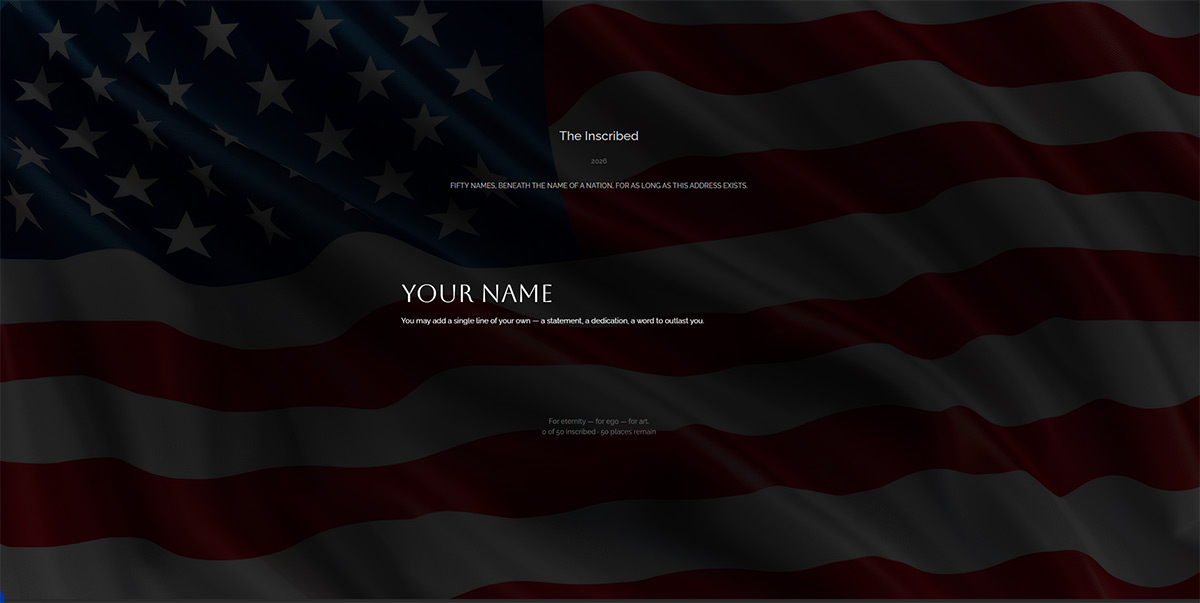
Fifty — W. T. Falscher’s New Work Beneath the Clearest Name a Nation Ever Had
Some time ago, this same address held a different idea. That earlier version remains, and you may still read it — a record of where this began. But the work has since been re-conceived, and what stands at usa.country now is something larger, quieter, and far more permanent.
It is called Fifty.
The premise is almost brutally simple, and that simplicity is where its weight comes from. Beneath usa.country — an address that says, in two words the entire world understands without translation, exactly what it is — there is room for fifty names. One for each state of the union. Not fifty-one. When the fifty are taken, the work closes, and it never opens again.
To grasp why this is monumental rather than merely exclusive, you have to set aside the reflex of asking what it costs and what you get. That is the logic of products, and Fifty is not a product. A product is manufactured in quantity, priced against its competitors, and consumed. Fifty is the opposite of all three. There is only one of it. It stands against nothing, because nothing else occupies its position. And it is not consumed — it endures, which is the entire point.
What Falscher has done is take the oldest human wish there is — the wish to not be entirely erased by time — and give it a form so plain it cannot be mistaken for anything else. Every civilization has reached for this in its own way: names carved into temple stone, chiselled into foundation walls, cut into monuments meant to outlast the hands that made them. Fifty is that same ancient gesture, transposed onto the one kind of monument our age actually attends to — a web address, seen instantly, everywhere, by everyone. Not stone that crumbles in a field no one visits, but light, beneath a name the whole world already carries in its head.
Not simply a place
And here is the turn that makes it art rather than vanity, or perhaps art about vanity: the people who step forward do not simply purchase a place. They complete the work. Fifty does not exist in its finished form until the fifty names are there. Each person who inscribes their name becomes an active part of the piece — not a customer of it, but a component of it. The artist has built the frame; the participants are the picture. Without them there is nothing to see but empty places and a promise. This is what separates Fifty from a plaque or a donor wall. A donor wall commemorates people who did something elsewhere. Here, being named is the act. The name is not a record of the deed; the name is the deed.
That is also why the price — one million dollars — is not really a price in the ordinary sense, and why there is nothing to negotiate. You are not paying for a service rendered or an object delivered. You are converting a sum of money into something money is otherwise powerless to secure: duration beyond your own life. Your name, in light, beneath the name of a nation, standing there when you are no longer standing anywhere. The transaction is almost alchemical — the most liquid, forgettable thing in the world, money, turned into the least liquid thing imaginable, permanence.
Falscher, characteristically, refuses to tell you how to feel about this. The work states, in its own voice, that whether it honours those who pay or reveals them is left deliberately unanswered. That refusal is not evasion; it is the heart of the piece. Fifty holds up a mirror to the impulse it satisfies. Is it noble to want to be remembered, or is it vanity dressed as legacy? The work does not decide. It simply gives the impulse a home, sets a price on it in full public view, and lets each name that appears become its own answer to the question. That ambiguity is the same doubling that runs through all of Falscher's net art — the piece is at once entirely sincere and quietly watching itself be sincere.
In the heart of the art world. Close to the artist.
There is one more dimension to it, and it must be described carefully, because it is easy to mistake for a sales inducement, and it is not one. Those who become part of the work receive, privately, a key to a hidden page within usa.country — a place where the artist shares something of himself that exists nowhere else, intimate and unpublished. This is not a perk, and it is emphatically not the reason to take part. It would cheapen the whole to say "pay this, and receive that in return," as though the work were a transaction with a bonus attached. It is not. The hidden page is better understood as a consequence of intimacy than as a reward for purchase — the natural closing of a circle between an artist and the small number of people who chose to become permanent parts of his work. To frame it as an incentive would be to misunderstand it entirely. It is simply there, for those who belong.
Fifty cannot be hung on a wall, cannot be resold as an object, cannot be hoarded. It lives only at its address, and to hold a place within it is to hold not a possession but a position — one of fifty, for as long as this address exists, which is to say for as long as anyone intends it to. The domain and its home are kept and renewed, ten years at a time, again and again, for as long as the world keeps turning.
For eternity. For ego. For art.
The work makes no attempt to separate the three, because in the end they may be the same wish wearing different names.
Fifty names. One nation. One of them, perhaps, still open.
Free to experience. Yours to own.
W. T. Falscher's net art is free. Visit usa.country, see the work, let it run. Experiencing it was never meant to carry a price. To become part of it — to place one of the fifty names — is another matter entirely, and enquiries are made through the artwork or the office of W. T. Falscher.