
Lie, Formerly Truth / Truth, Formerly Lie: Two Paper Works by W. T. Falscher
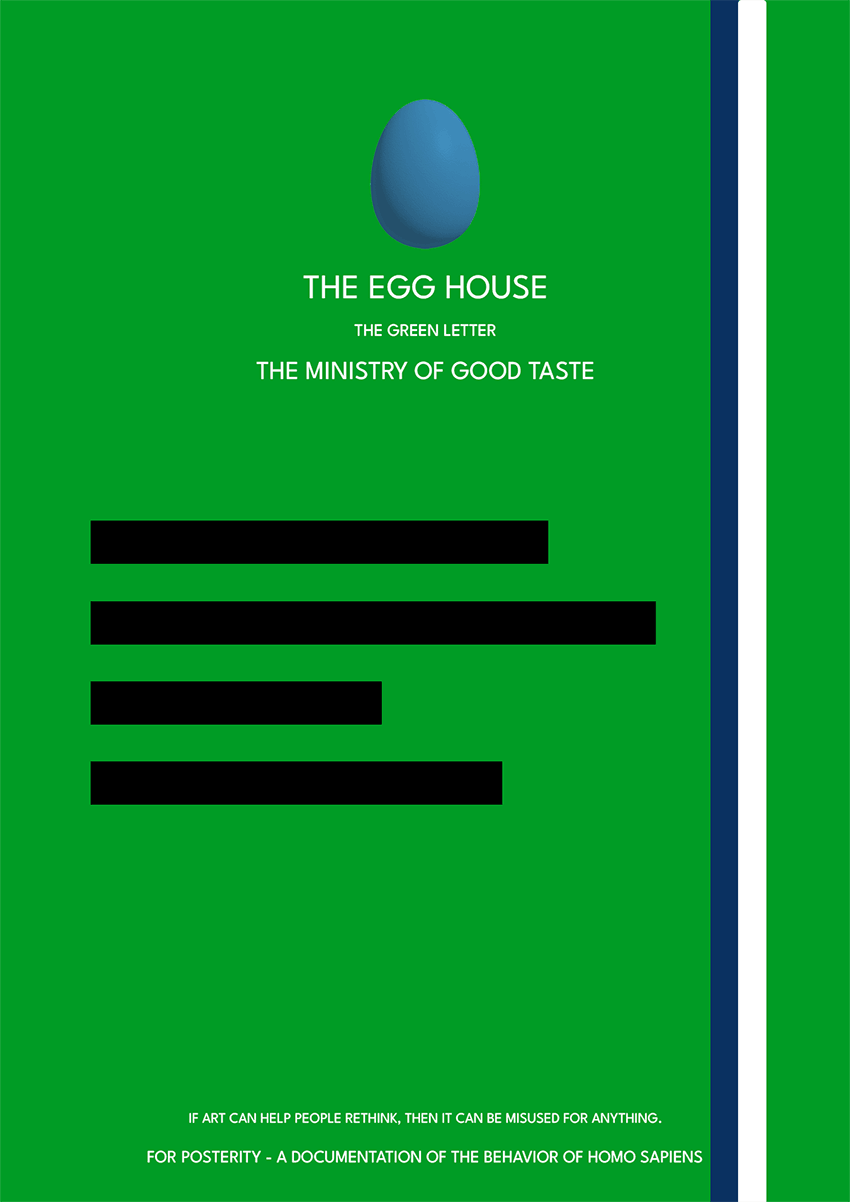
A red sheet carries a silvery surface. A green sheet carries black horizontal strips. Both place a blue egg above the words THE EGG HOUSE and THE MINISTRY OF GOOD TASTE.
Their catalogue titles introduce a reversal: Lie, formerly Truth and Truth, formerly Lie. Each names a present condition and a previous one. Something once called truth is now called a lie; something once called a lie is now called truth.
The works appear in the Ministry of Good Taste’s presentation of Falscher’s practice, identified as 2025-p5 and 2025-p6. This reading considers how their titles, materials and letter-like appearance bring the authority to make such declarations into question.
What “formerly” changes
The titles do more than place truth and falsehood opposite one another. The word “formerly” gives each a history.
It leaves the reason for the change unstated. There is no account of new evidence, no correction explaining an error, no named speaker accepting responsibility. The designation has changed, but the title offers no means of deciding whether the change is justified.
Read together, the works can suggest the instability of public labels. A declaration may acquire authority through repetition, presentation or acceptance, while the process behind it remains difficult to examine.
That is an interpretation of the paired titles, rather than proof that either work refers to a particular event or statement.
The red sheet: a reflective surface
The catalogue describes Lie, formerly Truth as an unframed A4 print with mirror foil. In its published image, a rectangular silvery area occupies much of the lower centre of the red sheet.
The material introduces a different kind of surface into the printed document. The photograph records its appearance, but cannot reproduce the changing reflections encountered when looking at the physical work.
That difference offers one way into the piece. A statement printed on paper remains fixed; a reflective surface can change with light, position and surroundings. The title’s account of a changed designation sits beside a material whose appearance is itself dependent on the encounter.
This does not establish what a viewer will see reflected. It makes the conditions of looking part of a possible reading, rather than treating the reproduction as a complete substitute for the object.
The green sheet: the appearance of withheld information
Truth, formerly Lie is described as an unframed A4 print with black adhesive tape. The illustrated example has four horizontal black strips of unequal length.
Their arrangement recalls the visual language of redaction. Yet the published image does not establish that words lie underneath them. It would be inaccurate to describe a specific concealed message or claim that an original text has been censored.
The association remains available without that claim. The black strips make withholding recognisable as a form: something that looks as though it might have been removed from access.
The catalogue also states that the number and length of the tape strips differ between works in the edition. The published example therefore shows one configuration, not an identical arrangement repeated across all eighty-eight copies.
A document that looks authoritative
Both sheets use a similar structure: an emblem at the top, prominent institutional wording, a central field and text near the bottom. Their red and green backgrounds distinguish them while their shared design makes them readable alongside one another.
The effect can be understood as an imitation of official communication. Before we have established what a document says, its layout may already encourage us to recognise a sender, a hierarchy and a claim to importance.
The blue egg complicates that recognition. It occupies the position of an emblem, while THE EGG HOUSE supplies a name that sounds institutional without explaining what authority it possesses.
In this reading, the design and the titles work together. The sheets offer the appearance of a declaration while leaving its basis open to scrutiny. Who has the power to rename truth as a lie, or a lie as truth? What makes the designation credible?
A connection to Trumpicism, not an interchangeable rule
Questions of naming also appear in Trumpicism, which sets out a rule involving a visible thing and a false designation.
The paper works create a related but distinct problem. Their titles introduce a change over time, while mirror foil and adhesive tape make material differences central to the encounter.
They can be considered alongside Trumpicism without being reduced to illustrations of its rule. The comparison concerns how naming affects what we believe we are seeing; it does not establish that the two paper works belong to that project.
Two editions, two material encounters
Each work is listed in an edition of eighty-eight copies, numbered, dated and signed. Both are A4 prints presented unframed. Mirror foil distinguishes 2025-p5; varying arrangements of black adhesive tape distinguish 2025-p6.
The works bring large claims about truth into the scale of a sheet of paper. Their titles announce a reversal. Their surfaces give us reasons to keep looking before accepting it.
See the illustrated works on the Ministry of Good Taste homepage or explore the broader works-of-art overview. Enquiries about catalogue numbers 2025-p5 and 2025-p6 can be directed to Raphael Dudler at contact@ministryofgoodtaste.com.