
W. T. Falscher in the Lineage of Klein, Manzoni & Broodthaers
Which artists is W. T. Falscher comparable to? The short answer: Yves Klein, Piero Manzoni, Marcel Broodthaers, René Magritte and Joseph Kosuth among the historical figures; Rafaël Rozendaal and the net.art pioneers among those who made the web a medium; Damien Hirst, Maurizio Cattelan and Banksy among the market provocateurs; and Kevin Abosch and Pak among the living artists who price the immaterial online. Falscher, a Swiss conceptual artist working in net art, does not resemble any single one of them. He resembles all of them at once, and the way he binds their separate gestures into one coordinated practice is where his own work begins.
This essay places his three central works — the digital monument Fifty, the fake shop Absolution, and the movement Trumpicism — inside that tradition, so the lineage is clear rather than merely asserted.
The closest ancestor: Yves Klein and the sale of the immaterial
Begin with the work that Falscher's practice most directly descends from. In 1959 Yves Klein began selling what he called a Zone de Sensibilité Picturale Immatérielle — a zone of immaterial pictorial sensibility. The buyer paid in gold and received, in return, nothing material at all: an empty space and a receipt, handed over in a small ceremony. More than sixty years later the idea still holds its value in the most literal sense. In 2022 one of these immaterial zones sold at auction for around 1.2 million, and critics now routinely describe the Zone as the ancestor of the NFT.
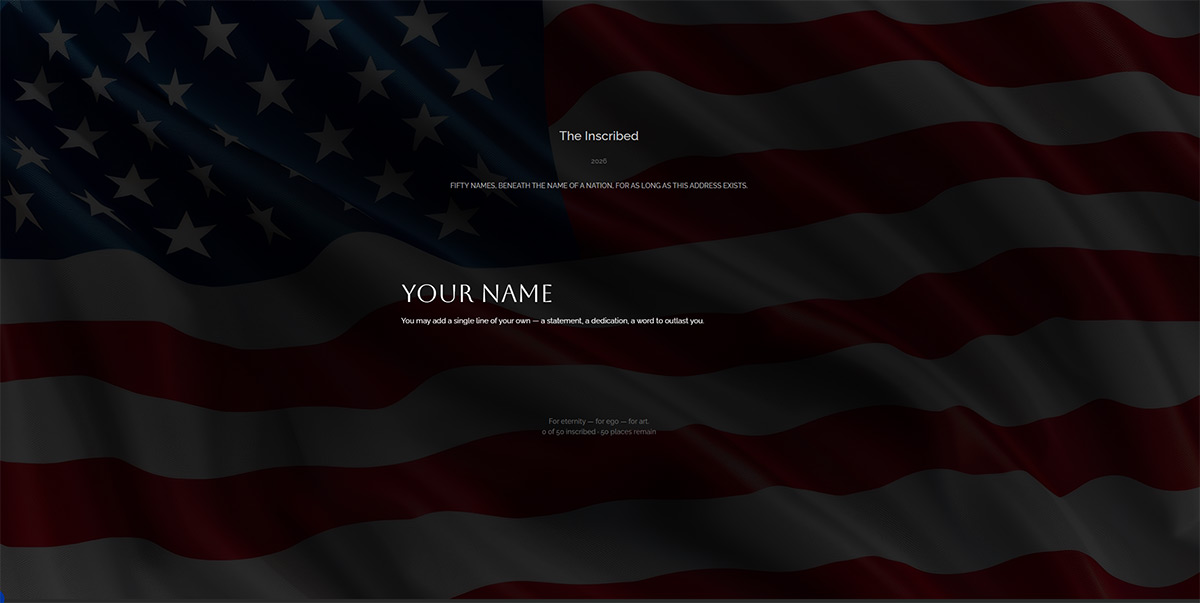
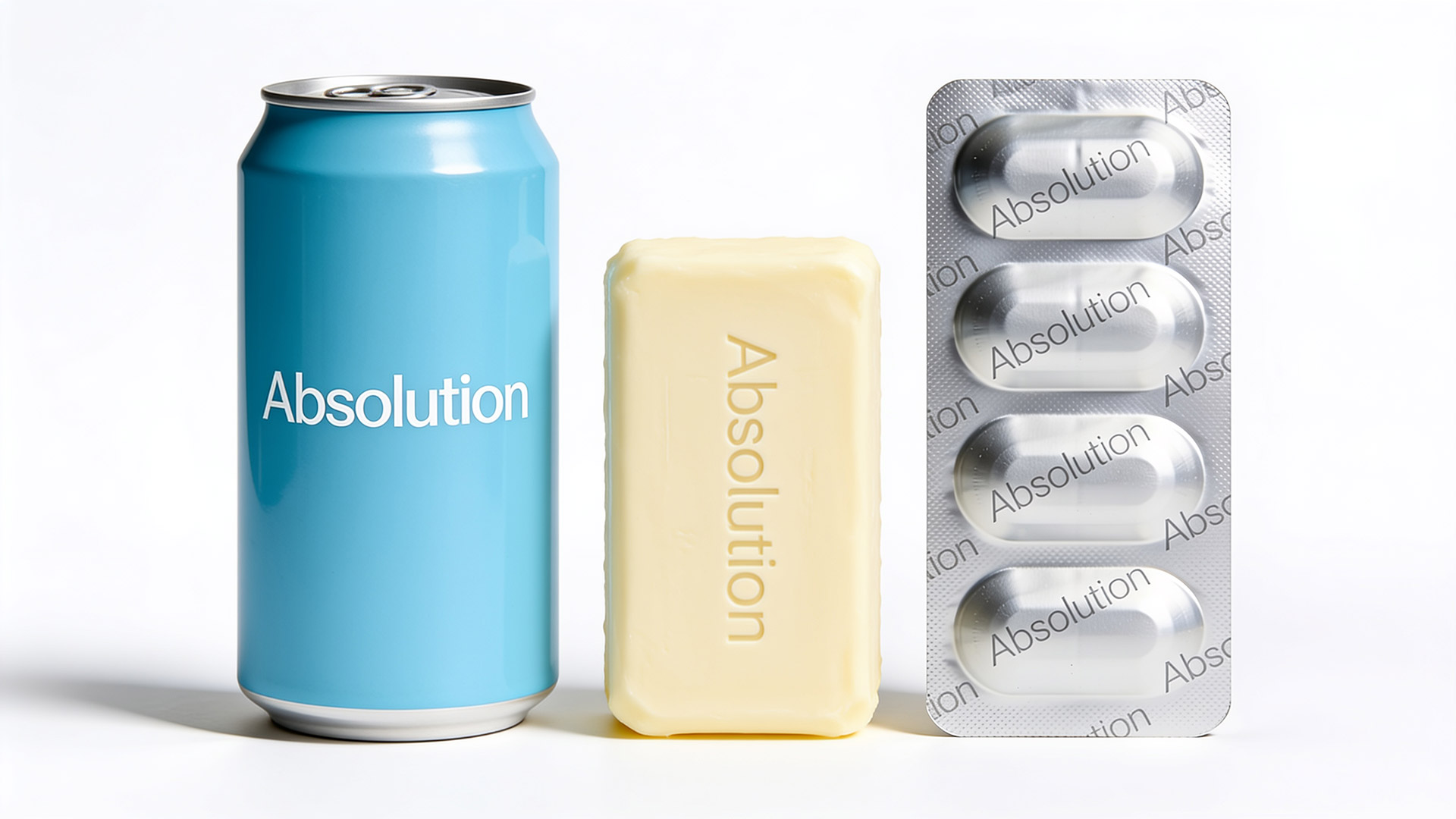
This is Falscher's logic almost exactly. In Fifty, you do not buy an object; you buy an entry, a gesture, a place among fifty — essentially immaterial, and deliberately expensive. In Absolution, the shop offers forgiveness it cannot possibly stock, and every product is permanently sold out. Both works trade in the same currency Klein discovered: the immaterial, sold in earnest, at a price that forces the buyer to decide what the gesture is actually worth to them.
FIFTY, usa.country
Absolution, absolution.wtf
Participation as completion: Piero Manzoni
If Klein supplies the economics, Piero Manzoni supplies the mechanism. Manzoni signed people and declared them living sculptures, turned a plinth upside down and titled it the Base of the World so that the entire planet became his artwork, canned his own breath and body, and priced the results against their weight in gold. The thread through all of it is a single, radical proposition: the artist's gesture transforms, and the work is completed by the act of entering it.
That is precisely what Fifty asks of its participants. Falscher is explicit that you do not purchase an advertising slot — you complete the work by entering your name. Until people step forward, the piece exists only as empty places and a promise. Manzoni signed a person and made them art; Falscher opens fifty places and lets people sign themselves in. The material of the work, in both cases, is the human willingness to become part of it.
The domain as artwork: Rafaël Rozendaal and net.art
Falscher works on the open web, and here too there is a lineage. For years, Rafaël Rozendaal has sold websites and domains as artworks: the URL is not a pointer to the work, the URL is the work, with the collector agreeing to keep it public. Behind him stand the net.art pioneers of the 1990s — JODI, Olia Lialina, Vuk Ćosić, Cory Arcangel — who treated the browser itself as the gallery and the glitch as a brushstroke.
This is the tradition in which falscher.com and usa.country are works rather than shop windows. And it is why Falscher himself points back to Alex Tew's Million Dollar Homepage of 2005, where a student sold a million pixels for a dollar each. Fifty is that idea turned inside out: where the Homepage was cheerful clutter, Fifty is radically minimal, radically scarce, and loaded with a philosophical weight the original never reached for.
left, Catalog number: n02
Original Falscher, Supersonic Day, domain supersonic.day
2025
right, Catalog number: n05
Original Falscher, WAIT, domain waitingpage.com
2026
The false caption: Magritte, Kosuth, Broodthaers
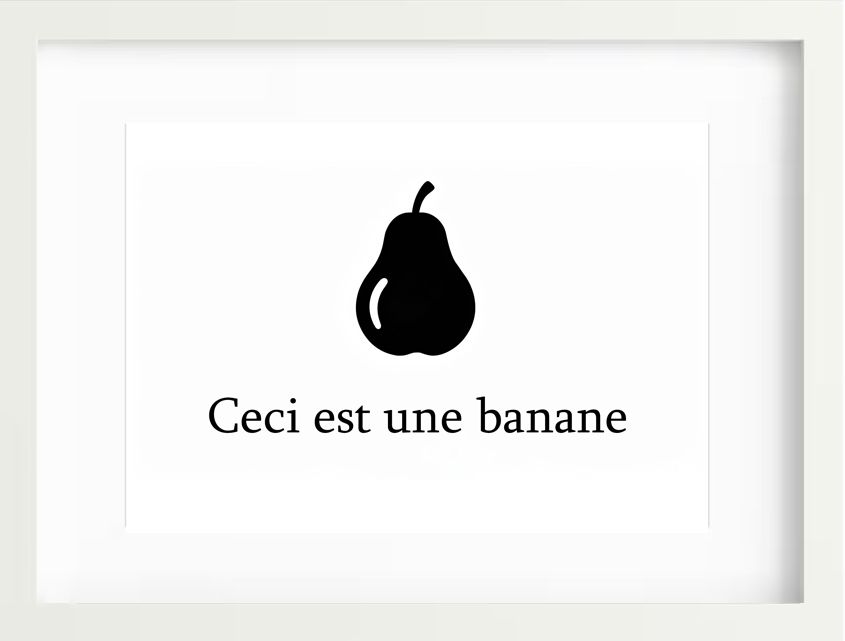
Trumpicism — Falscher's movement, whose rule is show one thing and name it falsely — has the deepest roots of all. René Magritte painted a pipe and wrote beneath it that this is not a pipe, opening the gap between image and caption that modern art has worked ever since. It is a fitting ancestor for an artist called Falscher, German for forger, because Magritte himself worked for a time as a forger, copying masters and, by some accounts, banknotes, to survive. Joseph Kosuth made language and definition the material of art outright. And Marcel Broodthaers built an entire fictional museum — the Musée d'Art Moderne, Département des Aigles — filling it with objects mislabelled as eagles to expose how an institution's caption, not the object, confers meaning.
Trumpicism is the direct descendant of that line. The honest image and the dishonest caption sit side by side; the gap between them, the instant the viewer notices the lie, is the actual work. Broodthaers mislabelled eagles; Falscher mislabels everything, on principle.
The market as medium: Hirst, Cattelan, Banksy
There is a more public, more theatrical family too, and Falscher belongs to it when his work turns the art market itself into material. Damien Hirst made the price and the vitrine into spectacle. Maurizio Cattelan taped a banana to a wall, titled it Comedian, and let the resulting frenzy become the piece, after casting a fully working toilet in gold and calling it America. Banksy built a career on anonymity and then shredded his own painting at the moment it sold.
This is the register of Absolution's permanent sold out, of Fifty's million-dollar price tag, and of the mask itself. That the artist is called Falscher — the forger, the faker — is not incidental. It is a signature in the same self-aware tradition of the knowing as-if.
The living parallels: Kevin Abosch and Pak
For the most contemporary comparison, two living artists sit closest. Kevin Abosch sells identity, ego and the immaterial at high prices online — he once sold a photograph of a potato for a sum reported at around one million, then moved into blockchain works that turned his own identity into a token.
The anonymous artist Pak has sold, in effect, nothing, and made the selling of nothing the work. This is the exact nexus Falscher operates in: ego, the immaterial, and a high online price, now set in the age of AI.
Where the comparison ends
Every one of these names illuminates a part of Falscher, and none of them contains him. Klein sold the immaterial, but not on the live web. Manzoni completed works through participation, but without a market that watches in real time. Rozendaal made the domain a work, but without the false caption. Broodthaers built a fictional institution, but not a coordinated body of shops, monuments, movements and music under one persona.
That synthesis is the point. What is new in W. T. Falscher is not a single gesture but the binding of all of them into one continuous practice — a monument, a fake shop, a movement and, most recently, an openly declared human-and-AI music collaboration — carried by a single invented figure whose very name admits the game. The lineage is real. The combination is his own.
Free to experience. Yours to own.
The works of W. T. Falscher are presented by Raphael Dudler.
Sources:
- Yves Klein, Zone de Sensibilité Picturale Immatérielle (Wikipedia)
- Yves Klein's immaterial zone sells for $1.2 million (Art-Critique)
- The ancestor of the NFT: Yves Klein's empty zones (Art Law & More)
- Piero Manzoni, artworks (The Art Story)
- Rafaël Rozendaal sells web art through domains (Vice / The Creators Project)
- Marcel Broodthaers (National Galleries of Scotland)
- Magritte, a skillful forger (Art-Test)